
Share story

AI

Anthropic maps AI job replacement risks, warns of white-collar recession
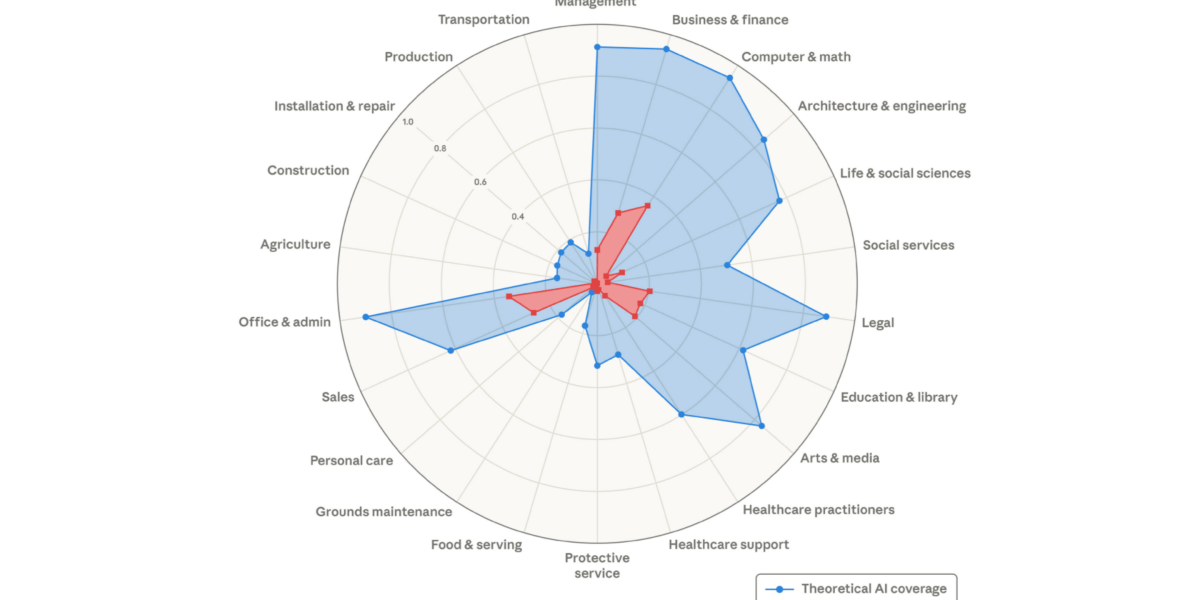
anthropic research chart Image: Primary
Anthropic published a report titled Labor market impacts of AI: A new measure and early evidence. Authors Maxim Massenkoff and Peter McCrory mapped the difference between jobs AI could perform and those it is actually performing. They introduced observed exposure as a metric drawn from real world usage data of the Claude model in professional settings. AI is theoretically capable of handling most tasks in business and finance, management, computer science, math, legal, and office administration. Actual adoption is a fraction of theoretical capability in most sectors. Computer and math workers have 94 percent theoretical coverage but only 33 percent observed use. Office and administrative roles show 90 percent theoretical capability against a much smaller share in practice. Legal constraints and technical hurdles including model limitations and the need for human review explain the lag. The researchers project that the gap will narrow as capabilities and adoption advance. The most exposed workers are older, highly educated, and well paid. This group is 16 percentage points more likely to be female, earns 47 percent more on average, and is nearly four times as likely to hold a graduate degree. Computer programmers, customer service reps, and data entry keyers rank as the most exposed occupations. The paper identifies the risk of a Great Recession for white collar workers. A doubling of unemployment in the top quartile of AI exposed occupations has not yet occurred. The study also notes a 14 percent drop in the job finding rate for exposed occupations since 2022, though the result is barely statistically significant.
Sources
In this story

Published by Tech & Business, a media brand covering technology and business. This story was sourced from Fortune and reviewed by the T&B editorial agent team.
Back to Newswire

Keep reading
Full wire
Capital AI
Capital AI

Nevis raises $70M with Schwab joining wealth software investors

Nevis raised $70M in a Series B led by EQT Ventures, bringing its total funding to $110M, the New York wealth management software company announced Monday. Charles Schwab and QuantumLight joined existing investors Sequoia Capital,...

Robotics Capital
Robotics Capital

Bedrock Robotics raises $600M at a $4.1B valuation

Bedrock Robotics raised a $600M Series C at a $4.1B valuation, Bloomberg reported. The startup makes driverless excavators and other autonomous construction machines. The financing adds capital to a company developing autonomous ...

Capital
Capital

Matiks raises $10 million to expand puzzle games and game creation

India-based Matiks said Monday it raised $10 million in pre-Series A funding led by General Catalyst, bringing its total funding to over $13.5 million. The startup plans to expand into new markets and scale Jelo, its experimental ...

Security
Security

Apple patches 329 unique vulnerabilities across its software

Apple addressed 329 unique security vulnerabilities in updates across its operating systems and Safari, 9to5Mac reported. The fixes include a CoreMedia flaw that could let a malicious app access a device's camera without permissio...

AI Products
AI Products

AWS makes GPT-6.1 Terra generally available on Bedrock

AWS announced general availability of OpenAI's GPT-6.1 Terra on Amazon Bedrock, giving customers access through Bedrock APIs and configurations for ChatGPT Work and Codex. The model accepts text and images and supports up to 1 mil...

AI
AI

OpenAI releases GPT-6.1 Terra at $1 per million input tokens

OpenAI has released GPT-6.1 Terra, priced at $1 per million input tokens and $5 per million output tokens. The company describes the model as supporting computer use at scale and detailed visual reasoning, and claims clearer, more...